


Usufruct rights for foreigners in multi-storey residential and commercial buildings in the Sultanate of Oman
2026-07-12
1,918 Views
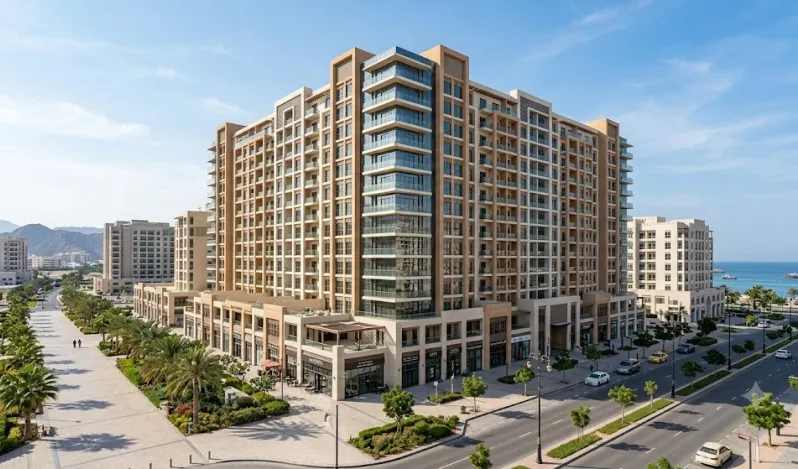


Until recently, foreigners wishing to buy property in Oman had only two options: either freehold ownership within Integrated Tourism Complexes (ITC) such as Al Mouj, Muscat Hills, and Yiti, or freehold ownership within future cities like Sultan Haitham City or Sorouh. Both options have specific restrictions and are located in designated areas far from regular residential neighborhoods in the heart of Muscat.
Today, the Ministry of Housing and Urban Planning has introduced a completely different third option: the usufruct system for foreigners in multi-storey residential-commercial buildings. Although this system does not grant full freehold ownership, it allows foreign residents in Oman to benefit from a residential unit in regular buildings within urban commercial neighborhoods—areas that were previously unavailable for any form of foreign ownership or usufruct before this decision.
We will explain this system in full: what it is, who is eligible, building and unit requirements, where it applies, the fees, and the registration procedures.
- What is the usufruct system for foreigners in Oman?
- Who is eligible to benefit from this system?
- Beneficiary requirements:
- Eligible building requirements
- Eligible residential unit requirements
- What does usufruct actually include?
- Designated areas for the system in Muscat
- Fees for registering usufruct rights
- Steps to register usufruct: the full procedure
- Quick comparison: Usufruct vs. Freehold in Oman
- Who is this system actually suitable for?
- Frequently Asked Questions
What is the usufruct system for foreigners in Oman?
Real estate usufruct is a legal right that allows the holder to use, exploit, and benefit from a property for a specified period of time, without transferring ownership of the property. The ownership remains with the original owner, while the beneficiary receives an officially documented right to live in, use, and benefit from the shared facilities for the agreed duration of the usufruct.
This system is used in many countries around the world under different names (Usufruct, Leasehold, Long-term Lease). What distinguishes the Omani version is that it is specifically targeted at foreign residents in the Sultanate who wish to settle in regular urban areas outside ITCs. It applies specifically to multi-storey residential-commercial buildings and not to all types of properties.
The fundamental difference from freehold: In freehold ownership in Oman (ITC, future cities, and Sorouh), the buyer owns the unit and land with a permanent title deed that is inheritable and can be sold at any time after fulfilling each category's requirements. In contrast, under usufruct, the buyer owns the right to use the property for a specified period not exceeding 50 years, extendable up to a total of 99 years. The unit cannot be sold until 4 years after the start of the usufruct unless the residency ends.
Who is eligible to benefit from this system?
This system does not allow foreigners residing outside Oman to apply. This is the main difference from freehold ownership, which does not require residency at all. The new system is exclusively for foreign residents in Oman, under the following conditions:
Beneficiary requirements:
- The beneficiary must be residing in Oman with a valid work residency of at least two years at the time of application
- Must be at least 23 years old
- Must not own another residential unit under the usufruct system anywhere else; only one unit is allowed
- The usufruct can be held individually or jointly with first-degree relatives only
These conditions place this system in a completely different category from the broader freehold system. It is aimed at foreign residents who work and live in Oman and want real residential stability, not distant foreign investors seeking investment returns or property-based residency in Oman.
Eligible building requirements
Not every building in the designated areas is eligible for this system. The Ministry of Housing and Urban Planning has set strict requirements for the building itself before allowing the sale of units under the usufruct system for foreigners:
- The building must be located within the designated geographic zones set by the ministry
- The building must be fully completed according to approved municipal plans; off-plan units cannot be sold under this system
- The building must not be older than 4 years from the date of the completion certificate; older buildings are excluded
- The building must have at least 4 residential floors; smaller buildings with two or three floors are excluded
- The building must be specifically multi-storey residential-commercial; it does not apply to villas, land, or purely commercial properties
Eligible residential unit requirements
In addition to the building requirements, there are specific conditions for the residential unit to be eligible for usufruct:
- The unit must have at least two rooms with facilities; studios and one-bedroom apartments are excluded
- The unit price must be OMR 45,000 or more in Muscat Governorate, and OMR 35,000 or more in other governorates. This minimum is set to regulate market prices and ensure no competition with local tenants
- The percentage of units sold to foreigners must not exceed 40% of the total residential units in the building
- The percentage of units sold to one nationality must not exceed 20% of the total residential units; this is to protect demographic diversity
What does usufruct actually include?
The usufruct contract under this system grants the beneficiary:
- Usage rights: Full use of the residential unit and all shared facilities in the building (elevators, parking, common areas), whether the beneficiary is alone or jointly with first-degree relatives.
- Financing rights: The beneficiary may mortgage the usufruct right to any financial institution to obtain financing for the unit purchase, meaning the purchase can be financed by banks with the usufruct right as collateral.
- Disposal rights: The beneficiary may sell the unit or transfer the usufruct after 4 years from the contract date, unless residency ends before that. If residency ends, disposal is allowed before the four-year period.
- Inheritance rights: The usufruct right passes to legal heirs after death according to Omani law.
- Duration: The usufruct period is specified in the contract, not exceeding 50 years, and may be extended so that the total period does not exceed 99 years.
Designated areas for the system in Muscat
In the first phase of implementation, the Ministry of Housing and Urban Planning designated Muscat Governorate as the only application area, with plans to expand to other governorates in later phases. The designated areas in Muscat are distributed across three wilayats:
- Wilayat Al Amarat: Al Amarat Al Hashiyah Phase 1, Madinat Al Nahda Phase 2, Madinat Al Nahda Phase 5, Al Amarat Al Mahaj Phases 1 & 2, Madinat Al Nahda Phases 3 & 4.
- Wilayat Bawshar: Bawshar Phases 1, 2, and 3, Al Misfah Phase 2, Ghala Heights Phases 1 & 2, Bawshar Al Wutayyah Phase 2, Al Khuwair Phase 2.
- Wilayat Al Seeb: Al Mawaleh 5, Al Khoudh 2, Al Maabela Phase 7.
All these areas are established, mature urban residential neighborhoods in the heart of Muscat, which fundamentally distinguishes this system from future cities or ITC areas located on the outskirts of the capital or in specialized tourist zones.
Fees for registering usufruct rights
The usufruct system imposes specific fees on both parties:
- Seller (unit owner): pays a fee of 3% of the unit value when applying for usufruct registration
- Beneficiary (buyer): pays a fee of 5% of the unit value
This means the total transaction carries an additional burden of 8% split between both parties, which is a key factor to consider when comparing this option to traditional renting or freehold ownership in other areas.
Steps to register usufruct: the full procedure
The registration process is conducted through the licensed electronic real estate brokerage platform and goes through nine official steps:
- The property owner submits the application through licensed real estate brokerage offices like Imtilak Global, and the application is submitted by the owner, not the beneficiary.
- Enter the location of the property and its usage type to verify it is within the ministry's designated geographic zones.
- Enter the building completion certificate to verify the building's age (must not exceed 4 years), which determines the actual completed units.
- Enter details of the residential and commercial units to determine the number of units permitted for sale under the usufruct system (not exceeding 40% of the residential units).
- Developer approval for the sale; in divided buildings with multiple owners, the owners' association must approve by a majority of over 50% according to an official record.
- Verify beneficiary requirements (buyer): residency and its duration, age, and not owning another unit under the usufruct system elsewhere.
- Verify the 20% nationality quota to ensure the set limit for each nationality in the building is not exceeded.
- Verify the price according to the price list available at the Land Registry, and collect the fees: 3% from the seller first, then 5% from the buyer.
- Issue the "usufruct deed" that officially documents the purchase under the usufruct system.
Quick comparison: Usufruct vs. Freehold in Oman
|
New Usufruct |
Freehold (ITC) |
Freehold (Future Cities) |
|
|
Who is eligible? |
Resident with work residency ≥ 2 years |
Any foreigner worldwide |
Any foreigner worldwide |
|
Minimum age |
23 years |
18 years |
18 years |
|
Minimum price |
OMR 45,000 (Muscat) |
None |
OMR 50,000 |
|
Allowed units |
Only one unit |
Unlimited |
Unlimited |
|
Type of ownership |
Usufruct (temporary) |
Permanent freehold |
Permanent freehold |
|
Duration of usufruct/ownership |
Up to 99 years |
Permanent |
Permanent |
|
Early sale |
After 4 years |
Upon building completion |
According to developer's terms |
|
Fees |
8% (3% seller + 5% buyer) |
Standard registration fees |
Standard registration fees |
|
Property-based residency |
Not explicitly included in the decision |
After building completion (OMR 50) |
After paying 30% (OMR 50) |
|
Areas |
Regular urban residential neighborhoods |
Integrated Tourism Complexes |
Future cities |
Who is this system actually suitable for?
This system is suitable for those who meet the requirements and want something specific that freehold ownership does not provide:
It suits you if you are: a foreign resident in Oman with valid residency for more than two years, and you want to move from repeated renting to stable, long-term housing, but your budget or preferences do not match ITC or future city projects. Stability in a regular urban neighborhood close to work, schools, and daily services may be more important to you than resort-like facilities in a remote location.
It does not suit you if you are: a foreigner outside Oman looking to buy property for investment or to obtain real estate residency in Oman. This system is closed to you, and you should consider freehold areas in ITC or future cities and Sorouh. It also does not suit you if you want a property that can be freely sold at any time or fully inherited.
At Imtilak Global, we help you evaluate all your options—new usufruct, freehold ownership—based on your actual situation: residency, budget, and purchase goals. The consultation is free and gives you a clear picture before any commitment, socontact us today for a personalized evaluation.
Frequently Asked Questions
What is the practical difference between two years of residency and specifically a work residency?
The system requires "work residency," not just any type of residency. Investment, visit, or dependent residency alone is not sufficient; it must be linked to a valid employment contract in the Sultanate.
What happens to the usufruct right if the beneficiary's residency ends?
If residency ends, the beneficiary may dispose of the unit (sell or transfer it) even before the usual four-year period required for selling.
Can the unit be rented out after obtaining usufruct?
The decision allows use and exploitation according to its regulations, but it is advised to review the contract terms with the licensed real estate brokerage to confirm rental permissions in each case.
Do you like this topic? You can share it with your friends now!


Do you like this topic? You can share it with your friends now!
More From Imtilak

Investment in Oman
Apartment rentals in Salalah during the autumn season and how to prepare for the annual peak


Investment in Oman
The top 7 freehold projects for Gulf nationals in the Sultanate of Oman 2026

Investment in Oman
The rise in real estate prices in the Sultanate of Oman by 22.7%: What does it mean for investors and buyers?