


Mistakes of new investors in the Omani real estate market
2026-07-13
1,358 common.blog.views
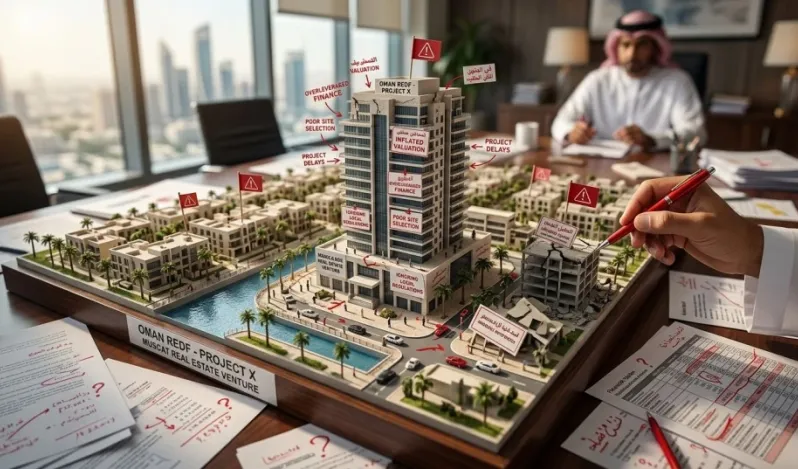


Most mistakes made by foreign investors in the Omani real estate market are conceptual, arising from reading the law partially or comparing it to other markets with completely different rules. This guide highlights 8 common mistakes among new investors, with an explanation of the legal or financial reason behind each one.
1. Believing that all properties in Oman are available for foreign ownership
This is one of the most common and costly mistakes. A new foreign investor may see an advertisement for an apartment in a residential area in Muscat and assume they can buy it, while in reality, foreign ownership in Oman is strictly limited to specific areas and categories.
Omani law allows foreigners freehold ownership in only three categories: Integrated Tourism Complexes (ITC) such as Al Mouj, Muscat Hills, and Yiti, Future Cities such as Sultan Haitham City, and specific Sarouh Projects, or the new usufruct system in residential buildings. Any property outside these categories is closed to foreign ownership regardless of what the seller or broker says.
Falling into this mistake means paying a non-refundable deposit on a property that cannot legally be registered in the foreign buyer’s name. The first step before any reservation is to confirm the project’s classification and its presence on the official list of licensed areas at the Ministry of Housing and Urban Planning or Omran Company.
2. Buying based on a different market model
For example, an investor coming from Dubai expects high liquidity and quick resale, while an investor from Turkey or Egypt expects markets similar to those they know. Neither expectation applies to Oman.
The resale market in Oman is less deep and liquid than Dubai, which means that real estate investment here suits a long-term horizon (5 years or more), not short-term speculation. Those aiming for quick profits from resale within a year or two often find themselves under pressure: a limited secondary market and contractual restrictions in some projects that prevent transfer before a certain payment percentage is made.
On the other hand, those seeking rental returns (5-8% annually in integrated projects) with a realistic time frame find a stable market with no tax on rental income until January 2028.
3. Ignoring the difference between developers
In a market still building its track record step by step, the reputation and operational history of the developer are more important than the project name and its reputation. New investors are often dazzled by marketing offers, attractive designs, and additional technologies without checking if the developer has delivered previous projects on time, whether they are partners with a government entity such as Omran or the Ministry of Housing, or if they work alone, and whether the project is officially registered and licensed by the competent authority.
The difference between an international developer with a verified track record and a government partner, and a local developer launching their first project, is a real risk difference that should factor into the price and decision.
4. Reading the sales contract superficially or ignoring it
The preliminary sales contract (SPA) is the document that governs everything that follows, and many investors sign it in haste or rely solely on the sales agent’s explanation without independent review.
There are four clauses to check before signing: the mechanism for linking payments to progress or fixed dates, the conditions for delivery delays and the compensation mechanism, the conditions for resale or transfer of contractual rights and whether a certain payment percentage is required, and the breach and contract termination clauses and their consequences regarding refund or forfeiture of the deposit. These are legal details that determine your actual rights in cases of delay or early exit.
5. Assuming all freehold ownership grants the same residency terms
Freehold ownership in Oman has two different tracks depending on the area and value. In Integrated Tourism Complexes (ITC), a two-year renewable residency is granted after construction is completed, increasing to 10 years if the property value is 200,000 OMR or more. In Future Cities such as Sultan Haitham City, residency can be obtained upon paying 30% of the property value during the construction phase itself without waiting for delivery.
6. Confusing the minimum purchase value with the family inclusion threshold
The property value of 50,000 OMR is the threshold that determines who is included in the residency application. If the property is below this value, residency is granted to the owner only. If the property is above, residency includes the owner, spouse, and children. An investor who buys a property for 46,000 OMR thinking it is enough for full family residency will later discover that only he is covered.
7. Thinking any property in Muscat is now freehold after the recent expansion
After the issuance of the new Real Estate Registry Law, Royal Decree 56/2026, and its executive regulations, the scope of foreign registration expanded beyond ITC exclusivity. This expansion includes the already licensed categories (Future Cities and Sarouh), not any regular residential neighborhood in Muscat. Buying a unit in a traditional residential area like Qaboos or Al Amirat, thinking it is freehold, often means the purchase was made under the usufruct system (use for up to 99 years without land ownership), which is fundamentally different in terms of rights and eligibility, as it requires a valid work permit of at least two years— a condition not required in freehold ownership.
8. Believing the advertised rental yield without checking demand type
The advertised rental yield in integrated projects generally ranges between 5% and 8% annually, but this figure is an annual average, not a fixed monthly rate. Projects with a tourism character, such as parts of Yiti projects, rely on seasonal rental demand, which means real fluctuations in occupancy rates between peak and off-peak seasons. An investor basing financial expectations on the annual figure without breaking it down monthly may find irregular cash flow that does not suit other financial commitments, even if the total figure at year-end is correct.
These eight mistakes share a single cause: a purchase decision based on part of the legal and financial picture instead of the full picture. At Imtilak Global, we help you see the whole picture before any commitment, from correct ownership classification to developer track record to contract payment details, through a free real estate consultation from local experts who follow every legislative update as soon as it is issued.
Read also: Properties for sale in Muscat for foreigners
Frequently Asked Questions
Do these mistakes apply only to new investors in the Omani market?
Most arise from transferring experience from other markets to the Omani market without adapting it. Even an investor with experience in other Gulf markets may make the mistake of confusing the three categories because their rules differ from the markets they are used to.
Is it possible to correct one of these mistakes after signing?
It depends on the type of mistake and the stage of the deal. Mistakes related to understanding residency terms can be adjusted later, but mistakes related to the type of ownership itself (freehold vs. usufruct) or the property’s location within a restricted area are difficult to address after signing. That’s why verification before, not after, is so important.
What is the difference between a mistake in choosing the project and a mistake in understanding the law?
A mistake in choosing the project (such as location or design not matching your goal) can be corrected by later resale or changing the usage plan. But a mistake in understanding the law (such as buying usufruct thinking it is freehold) affects the nature of your right itself and is much harder to correct.
common.blog.share_article


common.blog.share_article
common.blog.more_imtilak

Investment in Oman
Apartment rentals in Salalah during the autumn season and how to prepare for the annual peak



Investment in Oman
The top 7 freehold projects for Gulf nationals in the Sultanate of Oman 2026
Investment in Oman
The rise in real estate prices in the Sultanate of Oman by 22.7%: What does it mean for investors and buyers?