Registering children in schools in the Sultanate of Oman after obtaining a residence through real estate
2026-08-12
1,079 common.blog.views
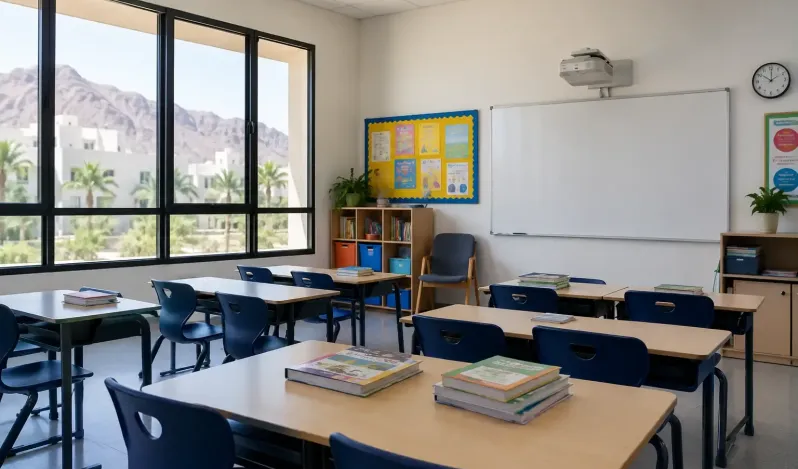


Once the real estate residency procedures are completed and family members receive their residency cards, enrolling children in schools becomes the next practical step for the family's settlement in the Sultanate of Oman. The Omani educational system offers two main tracks for expatriates: public schools for a specified fee, and private and international schools with varying curricula and fees. This guide explains the conditions and documents required for each track.
- Step One: Valid Residency Card as a Prerequisite for Registration
- Public Schools: Conditions and Fees for Expatriates
- Private and International Schools: The Most Common Choice for Expatriates
- How to Choose Between Public and Private Schools for Your Child?
- Projects with Educational Facilities Within Their Premises
- Frequently Asked Questions
Step One: Valid Residency Card as a Prerequisite for Registration
Before considering school selection, the child must have a valid residency card in the Sultanate of Oman, which is a mandatory requirement announced by the Ministry of Education for any registration application for a non-Omani child, whether in a public or private school. This means that completing the real estate residency procedures for the entire family, including children, is a step that must be accomplished before the school registration season, not in parallel with or after it.
Public Schools: Conditions and Fees for Expatriates
Expatriates can enroll their children in Omani public schools for tuition fees, as free education is limited to Omani citizens only. Certain categories are exempted or receive reduced fees, such as children from GCC countries (on a reciprocal basis), children from the Republic of Yemen, and children of non-Omani employees in the Ministry of Education (with a 50% discount). Registration is submitted electronically via the Manzara Platform of the Ministry, provided the child has a valid residency card. The minimum age for first grade registration is six full years at the start of the academic year. Required documents include a copy of the passport with the residency page, the child's medical record, and the child must undergo medical examinations from accredited government health institutions.
Private and International Schools: The Most Common Choice for Expatriates
Many expatriate families prefer private and international schools, which offer multiple curricula accredited by the Ministry of Education and sometimes additional international accreditations such as Cambridge, Edexcel, or Cognia. Fees vary greatly depending on the type of curriculum: schools following the national curriculum are usually less expensive, while fees are higher at schools with fully foreign or international curricula. When comparing schools, it is advisable to check the official accreditation by the Ministry, the qualifications of the teaching staff, and what the fees actually cover (transportation, activities, additional learning support), not just the total amount.
How to Choose Between Public and Private Schools for Your Child?
The decision depends on the family's priorities: public schools are suitable for those seeking deeper integration into the Arabic curriculum and language with relatively lower costs, while private or international schools suit those who want continuity in an educational system similar to what the child followed in their home country, or preparation for a future international university path. Both options are legally available to resident expatriates, provided the residency and document requirements for each track are met.
Projects with Educational Facilities Within Their Premises
For families who prefer to minimize daily commuting distance to school, some of our projects include educational facilities within the project itself or in its immediate vicinity, such as Hay Al Wafaa in Sultan Haitham City, which includes colleges, a university, and public school complexes, as well as a private international school, making it a practical choice for those seeking direct proximity to a variety of educational options. Additionally, The Sustainable City in Yiti includes a school and nursery within its integrated facilities, allowing resident families access to essential educational services without the need to travel outside the project area.
Read also: Properties for Sale in Muscat for Foreigners
Registering children in schools is a straightforward step once their real estate residency is completed, whether the family chooses the public or private track. For those who want to simplify this step even further, choosing a property within a project that includes integrated educational facilities, such as Hay Al Wafaa, The Sustainable City, or others, reduces daily commuting considerations from the very beginning of settling in Oman.
The Imtilak Global team helps families choose the property that serves their complete family plan, from residency to proximity to suitable educational options for their children. Speak with our real estate consultants to review the most suitable projects for your family based on these considerations.
Frequently Asked Questions
Can a child be registered in a school before completing their real estate residency?
No, a valid residency card for the child is a mandatory requirement announced by the Ministry of Education for registration acceptance, whether in public or private schools.
What is the main cost difference between public and private schools for expatriates?
Public schools charge fees for non-Omanis but they are generally lower compared to private schools, whose fees vary greatly depending on the type of curriculum (national versus fully international).
Do private school fees include additional services such as transportation?
This varies from one school to another, and it is advisable to specifically check what the announced fees cover (transportation, activities, learning support) before comparing schools based only on the total amount.
common.blog.share_article


common.blog.share_article